
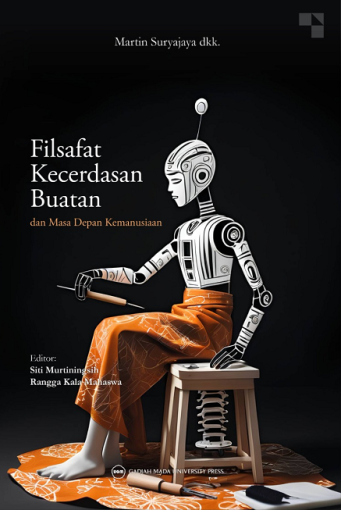
The Faculty of Philosophy at Universitas Gadjah Mada (UGM), in collaboration with UGM Press, has published a book titled Philosophy of Artificial Intelligence and the Future of Humanity. This book is the result of a multidisciplinary collaboration involving 20 authors from various fields, spanning the social sciences, humanities, and science and technology disciplines—including philosophy, medicine, and other related fields. The book was edited by Prof. Dr. Rr. Siti Murtiningsih, S.S., M.Hum., and Rangga Kala Mahaswa, S.Fil., M.Phil.
This book examines the relationship between philosophy and artificial intelligence (AI) from philosophical, ethical, and public policy perspectives. Broadly, it is divided into three main sections, each highlighting different aspects of AI studies.
The first section explores ontological and epistemological issues related to artificial intelligence. One of the fundamental questions discussed is whether AI can possess parahuman cognition or intelligence equivalent to that of humans. Additionally, the book addresses philosophical challenges concerning qualia, consciousness, and interpretation within the context of the philosophy of mind and meta-ethics. From a theological hermeneutic perspective, the book also raises questions about whether AI can comprehend and interpret meaning as deeply as humans do.
The second section focuses on AI ethics, highlighting moral dilemmas in AI applications across various sectors. Topics covered include the impact of AI on the workforce, copyright issues, data security, and the sustainability of human life amidst rapid technological advancements. One particularly intriguing discussion revolves around AI implementation in healthcare services, including the morality of AI-based decision-making and the ethical responsibility of AI technology’s impact on animal welfare.
Meanwhile, the third section addresses policy challenges and AI governance in the Indonesian context. The chapters in this section examine AI’s role in national resilience, the sustainable management of biodiversity, and adaptive policies in response to AI advancements. The book also explores AI’s impact on scientific knowledge production in Indonesia, including debates over the use of technologies such as ChatGPT in academia and research. A key issue raised is whether AI can be considered an author or a legitimate reference in scientific works.
Overall, Philosophy of Artificial Intelligence and the Future of Humanity presents critical and reflective questions on how AI influences various aspects of human life. From metaphysics to epistemology, from ethics to public policy, this book offers a comprehensive perspective on the challenges and opportunities AI presents for the future of humanity.
Through this publication, the Faculty of Philosophy UGM aims to contribute to broader intellectual discussions on AI’s development and its social, cultural, and moral implications. The book is expected to be an essential read for academics, researchers, students, and policymakers interested in the philosophical dimensions of artificial intelligence.