
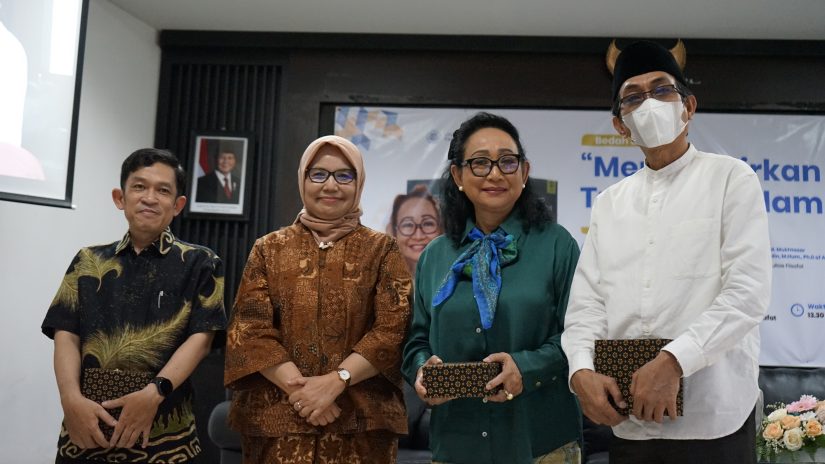
The Faculty of Philosophy, Universitas Gadjah Mada (UGM), held a book discussion on Menghadirkan Tuhan di Dalam Diri (Bringing God Within Oneself) by Dr. Sri Teddy Rusdy on Friday, August 15, in the Persatuan Meeting Room, 3rd floor of the Faculty of Philosophy. The event, part of the 58th Anniversary celebration of the Faculty of Philosophy, was attended by philosophy students as well as the general public.
Chair of the 58th Anniversary Committee, Moch. Najib Yuliantoro, S.Fil., M.Phil., in his opening remarks, highlighted that the discussion invited participants to revisit the roots of Javanese civilization, which places the cultivation of inner feeling (olah rasa) and the cultivation of the soul (olah jiwa) as the highest virtues of life.
“Today we learn about Javanese civilization, which is rooted in the civilization of the soul, placing olah rasa and olah jiwa as the highest virtues in life. The concept of kawruh Jawa is highly original, rational, and modern. What is interesting in this discussion is the critique reflected in spiritual thought that resists irrational mysticism and superstition. Together, we will learn from the author’s spiritual dialogue on the subject of divinity. From this topic, we may open wider horizons in understanding humanity, justice, and even the values we know today as Pancasila,” he explained.
In his presentation, Dr. Sri Teddy Rusdy explained that the book Bringing God Within Oneself is a reflection of his decades-long engagement with the thought of Ki Ageng Suryomentaram, which he finds to be deeply relevant as a guide to life today.
“Bringing God Within Oneself: A Spiritual Dialogue with Ki Agung Suryomentaram. My acquaintance with Ki Agung Suryomentaram has been quite long, perhaps more than 30 years. I read, I understood, and I tried to study his works. After considering several of his ideas, I find them to be quite relevant as guidance for our daily lives. Why do humans worship God? The first thing observed by Ki Ageng is the expression of gratitude to the Almighty,” he elaborated.
The discussion was further enriched by two respondents, Prof. Drs. M. Mukhtasar Syamsuddin, M.Hum., Ph.D. of Arts, and Dr. Fahruddin Faiz, M.Ag., both of whom offered appreciation and critical notes on the book, particularly regarding its philosophical, theological, and practical dimensions in the effort to bring God into daily life.
The event ran interactively, with enthusiastic participation from students and the general public alike. Through this book discussion, the Faculty of Philosophy not only celebrated its academic journey but also expanded the space for dialogue on humanity, justice, and national values within the framework of spirituality and philosophy.