
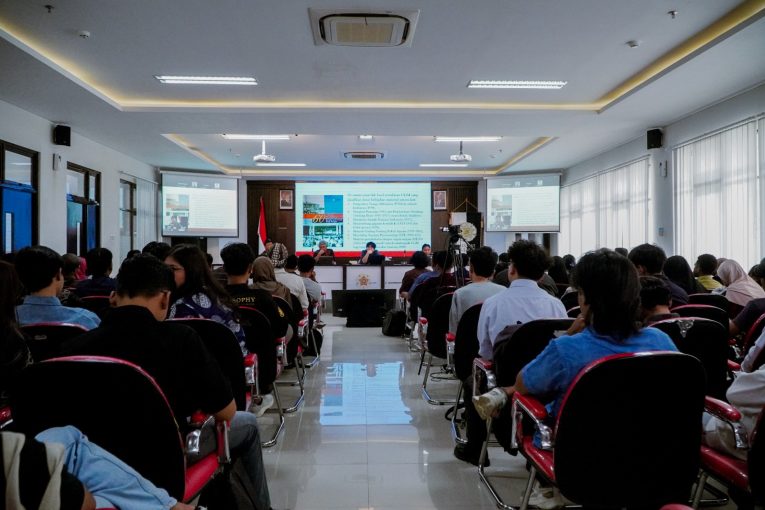
The Faculty of Philosophy of Universitas Gadjah Mada (UGM) held the 2025 National Symposium on Nusantara Philosophy under the theme “Decoloniality, Epistemic Justice, and the Future of Nusantara Philosophy” on Tuesday, 28 October 2025, at the Persatuan Conference Room, Faculty of Philosophy UGM. The symposium served as an important forum for academics, researchers, and scholars of philosophy to discuss the future direction of Nusantara philosophy amid global challenges.
The symposium is a regular academic agenda organized by the Laboratory of Nusantara Philosophy (Lafinus). In her opening remarks, the Dean of the Faculty of Philosophy UGM, Prof. Dr. Rr. Siti Murtiningsih, S.S., M.Hum., emphasized that discussions on Nusantara have often remained influenced by Western perspectives. “When we speak about Nusantara, the perspective is almost always Western. Amid the dynamic tensions within it, decoloniality and epistemic justice become compelling themes for further discussion,” she stated.
Serving as moderator, Dr. Rodinal Khair K. underlined that the symposium was designed as a collective effort to clarify pathways for the development of Nusantara philosophy. “If we look at the global development of philosophy, several traditions have already become well-established, many of which are grounded in indigenous philosophy. This symposium is intended as a space for us to contribute ideas on how we can develop Nusantara philosophy in the future, including its methodologies,” he explained.
The first presentation was delivered by Dr. Heri Santoso (Universitas Gadjah Mada), who highlighted the importance of decolonial awareness in thinking and philosophizing. He reminded the audience that although colonialism has formally ended in political terms, its traces persist in patterns of thought.
“Looking at Indonesian history, even though the colonizers have left, a colonial—or inlander—mentality still lingers. Anything perceived as foreign is often valued more highly. The greatest form of colonization is not only political, legal, or state-based, but colonization of ways of life, ways of thinking, and ways of knowing,” he asserted. According to Heri, philosophical inquiry must be grounded in the nation’s socio-historical, cultural, and religious contexts in order to remain critical, historically aware, and meaningful.
Meanwhile, Dr. A. Setyo Wibowo (STF Driyarkara) elaborated on the distinctive characteristics of Indonesian modes of thought in contrast to Western traditions. He explained that Nusantara philosophy tends to resist rigid dichotomies and confrontational dialectics.
“Indonesian ways of thinking are anti-dialectical, have a strong appreciation for paradox, and avoid strict oppositions. They emphasize laku or practice rather than final truths—the process is what matters. Our philosophy is also mystical, transcendental, and oriented toward cosmic harmony,” he explained.
From the perspective of cultural and political philosophy, Min Seong Kim, Ph.D. (Universitas Sanata Dharma) offered a critical reflection on the meaning of “Nusantara” within Indonesia’s ideological imagination. According to him, “‘Nusantara’ operates as a central signifier in Indonesia’s cultural, ideological, and geopolitical imagination.”
He further noted that within state discourse, Nusantara is often domesticated into a “cultural reservoir” subordinated to state ideology. “State discourse demands that Nusantara function as a source of national character and ideological legitimacy, while simultaneously disciplining its richness and diversity to conform to the idea of unity,” Kim explained.
The final presentation was delivered by Dr. Luh Gede Saraswati Putri (Universitas Indonesia), who highlighted the practical and spiritual dimensions of Nusantara philosophy. She argued that the distinctiveness of Nusantara philosophy lies in the interconnectedness between humans, nature, and the spiritual realm, as well as in direct lived experience.
“Nusantara philosophy cannot be separated from laku, or ways of life, that emphasize the interconnectedness of humans, nature, and spirit. There is a strong emphasis on direct experience and the spontaneity of the subject. Its philosophy cannot be detached from action and collective practices,” she stated.
The symposium fostered rich dialogue between tradition, social context, and academic reflection. Decoloniality and epistemic justice were discussed not merely as theoretical concepts, but as ethical calls to cultivate modes of thinking rooted in local experience and wisdom. Through this event, the Faculty of Philosophy UGM reaffirmed its commitment to serving as a space for the development of Nusantara philosophy that is inclusive, critical, and relevant to the nation’s future.