
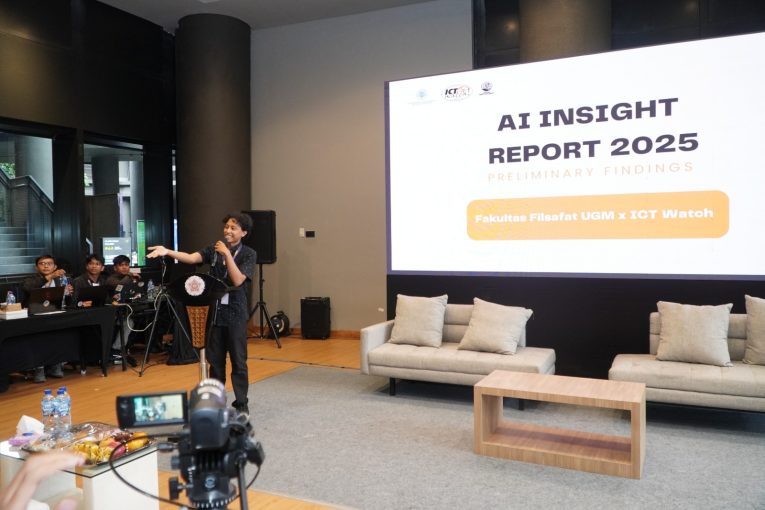
The Faculty of Philosophy at Universitas Gadjah Mada (UGM), in collaboration with ICT Watch, presented the preliminary findings of a joint research project titled AI Insight Report 2025 as part of the AI Literacy Summit. The findings were delivered by researcher Luthfi Baihaqi Riziq, offering an early overview of how Indonesian society—particularly Generation Z—relates to artificial intelligence (AI).
The study employed questionnaires and in-depth interviews with Generation Z respondents from across Indonesia, as well as informants from the industrial sector, government, and civil society organizations. It adopted a postdigital approach, viewing AI not merely as a digital technology but as embedded within physical infrastructure, governance systems, access distribution, and human–technology relationships.
The findings indicate that the majority of respondents consider digital infrastructure a key factor in AI adoption. As many as 89 percent of respondents stated that improvements in internet quality, affordability, and data connectivity are essential prerequisites for effective AI use. “Improving internet quality is a crucial condition for driving AI adoption,” Luthfi explained.
In terms of governance, 64 percent of respondents expressed confidence in the government’s capacity to develop digital infrastructure, although concerns remain regarding inclusivity and policy transparency. On social inclusion, the research found that AI presents both opportunities and challenges. While 76 percent of respondents believe AI helps persons with disabilities use social media more safely, 65 percent noted that limited accessibility features still constrain its full utilization.
In the economic sphere, some respondents indicated that AI has the potential to widen disparities between high- and low-income groups, as well as affect job security. “AI creates opportunities for inclusion, but accessibility barriers remain a tangible issue,” he added.
From a personal perspective, Generation Z demonstrates a high level of engagement with AI. Around 75 percent of respondents reported frequent use of AI in daily life, 71 percent expressed satisfaction with its use, and 60 percent acknowledged a degree of dependence on AI. The presentation highlighted that this close engagement is accompanied by an awareness of potential dependency. Most respondents also believe that mastering AI-related skills fosters new competencies beneficial for both professional and personal life.
The study further revealed that many respondents perceive AI as offering more benefits than drawbacks, with tangible impacts on both personal and professional domains. However, concerns related to environmental impact, equitable access, and human–technology relations remain central in discussions on the future development of AI.
Through the presentation of these findings, the Faculty of Philosophy UGM and ICT Watch underscored the importance of a human-centered approach in understanding the evolution of artificial intelligence. The study is expected to serve as a foundation for advancing AI literacy that emphasizes not only technical proficiency but also ethical and social reflection amid ongoing digital transformation.