
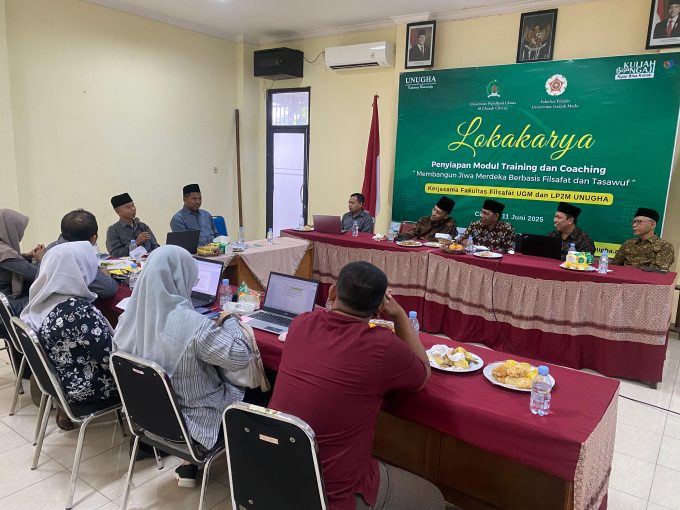
As part of its commitment to fostering holistic and conscious education, the Faculty of Philosophy at Universitas Gadjah Mada (UGM), in collaboration with Universitas Nahdlatul Ulama Al Ghazali (UNUGHA) Cilacap, organized a workshop on developing a training and mentoring module entitled Building the Independent Soul through Philosophy and Sufism.
This initiative was led by three lecturers from the Faculty of Philosophy—Imam Wahyudi, M.Hum., Dr. Heri Santoso, and Dr. Abdul Malik Usman, M.Si.—as a form of community service and as a concrete follow-up to the memorandum of understanding between UGM and UNUGHA. The workshop marked an initial step in designing training and coaching approaches for educators, with the hope of strengthening inner resilience and spirituality in addressing the challenges of contemporary education.
“It is impossible for education to liberate human beings if the educators themselves have not yet experienced freedom of the soul. Therefore, the effort to cultivate the inner resilience and clarity of heart among teachers and lecturers becomes crucial in responding to the increasingly evident crisis of the human psyche in today’s era,” stated Imam Wahyudi.
Heri Santoso also emphasized the importance of distinguishing between training, counseling, mentoring, and coaching. “Training and coaching approaches rooted in local wisdom and the teachings of Islam Nusantara provide a way to help people break free from inner shackles and the pressures of life,” he explained.
He further cited figures such as Gadjah Mada, Ki Hadjar Dewantara, Soekarno, and Buya Hamka as examples of individuals who attained inner freedom—even though they had at times been imprisoned physically. Heri posed a reflective question: why is it that today, many educators who are not imprisoned often do not feel truly free and whole within themselves?
In a presentation warmly received by participants, Heri introduced the concept of the Three-Step Formula as a method of cultivating an independent soul: asking the Qur’an, asking the Asmaul Husna, and asking one’s conscience. This method has been applied in limited forums and has shown positive results in helping individuals find inner peace and direction.
Meanwhile, Abdul Malik Usman elaborated on the idea of Sufism as a path of spiritual liberation. He stressed that true Sufism is a conscious effort to free oneself from the impulses of the ego, worldly desires, and illusions of power. Referring to the thoughts of figures such as Al-Ghazali, Iqbal, and Ali Shari’ati, Malik explained that inner freedom is the foundation for becoming a complete and liberated human being.
This program also received strong support from UNUGHA. The Chairman of the UNUGHA Foundation, KH Lubbul Umam, and the Head of LPPM UNUGHA, Fahrur Rozi, M.Hum., expressed their appreciation for this strategic collaboration with the UGM Faculty of Philosophy. “It is our hope that this program will result in a training module that not only touches upon the cognitive aspects but also fosters inner depth and spiritual maturity among educators,” they remarked.
Also present at the forum were Kiai Sudirwan and several Sufism experts from UNUGHA, who enriched the discussions. Through this meeting of philosophy and Sufism in the context of community service, the UGM Faculty of Philosophy once again reaffirmed its contribution to cultivating the whole human being—not only through theory but also through practical approaches rooted in local values and the spirituality of the Nusantara tradition.