
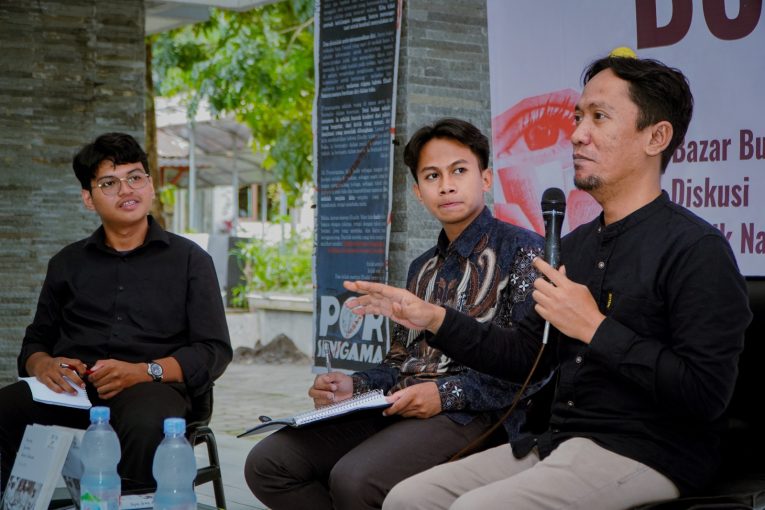
As part of the Philosophy Book Fair and the National Symposium on Nusantara Philosophy, the Faculty of Philosophy of Universitas Gadjah Mada (UGM) held a book discussion on Saya, Jawa, dan Islam by Irfan Afifi on Monday (27/10) at the Faculty of Philosophy’s Selasar. The event featured the author himself as the main speaker, with Fahri Jundi serving as the respondent.
Saya, Jawa, dan Islam is Irfan Afifi’s debut book. The writings compiled in the volume reflect the author’s ongoing inner and reflective struggle to understand himself and his existence as a Javanese individual who practices Islam. Although the book was not initially conceived as a single, unified work, it ultimately reveals a coherent intellectual and spiritual journey shaped by the author’s prolonged contemplation.
In the book’s introduction, Irfan explains that this search is rooted in self-awareness—the effort to recognize who he is, where he comes from, and where he is heading. “As a Javanese person who is Muslim, I must be willing to accept the inevitability that I was ‘forced’ to be born in a hamlet in Java, along with all the traditions, cultural frameworks, and daily practices that have shaped me,” he writes.
During the discussion, Irfan emphasized that the book did not emerge solely from academic work, but from a long process of lived practice and inner struggle. “From that struggle, this book was born. It is not merely my intellectual work, not just research. It is my laku—my lived practice—driven by a questioning soul. It is a record of a spiritual journey and an intellectual struggle as a human being who exists,” he explained.
He further noted that the work is deeply rooted in personal experience that began at the Faculty of Philosophy, UGM. “What I want to emphasize is that this story is related to my inner turmoil that started in this Faculty of Philosophy. If you work, ask questions, and do something by fully involving your innermost soul, then your work will have a soul—it will surely move others,” he said.
Irfan also conveyed that one of the book’s central motivations is to challenge colonial scholars’ perspectives on Javanese culture. “I feel that earlier researchers did not study Java with pure objectivity; they studied us in order to subjugate us. As a result, their biases could be intentional, unintentional, or even unconscious on the part of the researchers themselves,” he remarked.
The discussion unfolded in a warm and reflective atmosphere, inviting participants to explore the relationship between philosophy, tradition, and spirituality within the context of Javanese identity and Islam. Through Irfan Afifi’s personal narratives and reflections, participants were encouraged to understand that philosophical struggle is not merely a matter of rational inquiry, but also a journey of the soul and existential awareness.