
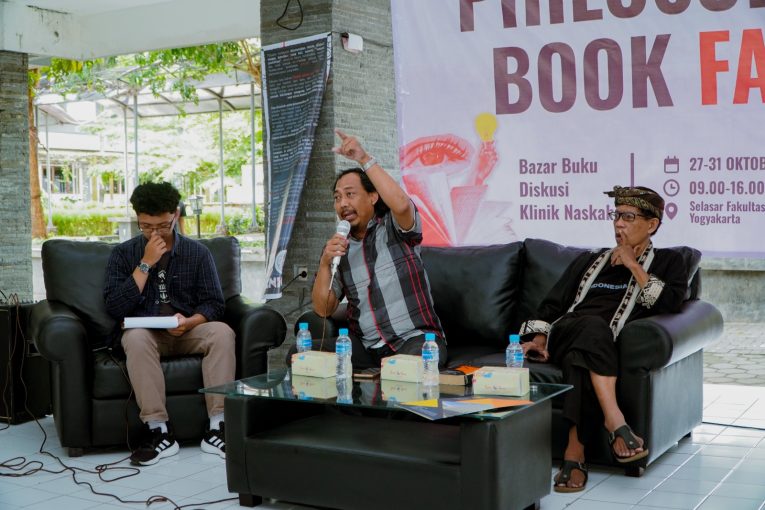
On Thursday, 30 October 2025, the Faculty of Philosophy held a Book and Culture Discussion featuring cultural thinker Taufik Rahzen and writer Aguk Irawan. The event offered a renewed reflection on the role of books, scripts, and literary traditions as custodians of Nusantara’s collective memory, as well as arenas of cultural contestation amid the rapid expansion of digital culture.
In his presentation, Taufik Rahzen invited the audience to revisit the significance of ancient inscriptions as key markers in the course of Indonesian civilization. He referred to the Kutai Yupa, the Tugu Inscription, and various other inscriptions not merely as administrative records, but as “cosmological codes that record the long cycles of Nusantara’s history.”
He explained that the cycles of 400 to 1,600 years known in local cosmological traditions appear repeatedly at critical historical moments, such as the construction of Borobudur in 824 CE, the rise of Majapahit in 1224 CE, and the era of Sultan Agung in 1624 CE. “We actually live within patterns far larger than we often imagine. These inscriptions were not read only yesterday; they recorded the direction of history long before we were born,” he remarked.
Rahzen also discussed the Kalangwan, an elite group of knowledge keepers in Nusantara who used Kawi script not merely as a means of communication, but as a medium for encoding knowledge. He emphasized that many layers of meaning in ancient texts cannot be fully grasped through modern linguistic approaches alone. “Our scripts were not just letters; they were mandalas of consciousness. When those scripts disappear, we lose a way of reading ourselves,” he stated.
Meanwhile, Aguk Irawan focused on the relationship between language and the creation of reality. He cited Ibn Arabi’s notion that the world comes into being through the word—kun fayakun. In this context, Aguk described books not as inert objects, but as “vessels of values, morality, and civilization.” He added that despite today’s flood of digital information, the role of words as a medium of knowledge remains irreplaceable. “Technology comes and goes, but meaning can only be preserved through language. Books are the home of that meaning,” he emphasized.
Both speakers then reflected on historical periods in which strong literary cultures formed the foundation of civilizational renewal, such as the era of Al-Ma’mun’s large-scale translation movement and postwar Japan, which turned to books and education as pathways out of devastation. These examples, according to Aguk, demonstrate that no society can grow without a solid foundation of literacy.
The discussion also addressed the challenges of the digital age. While increasingly open access to information offers significant opportunities, it simultaneously gives rise to a crisis of meaning and a loss of depth. Concluding the discussion, both speakers agreed that books, scripts, and reading traditions remain the backbone of civilization, even as their forms continue to evolve over time.