
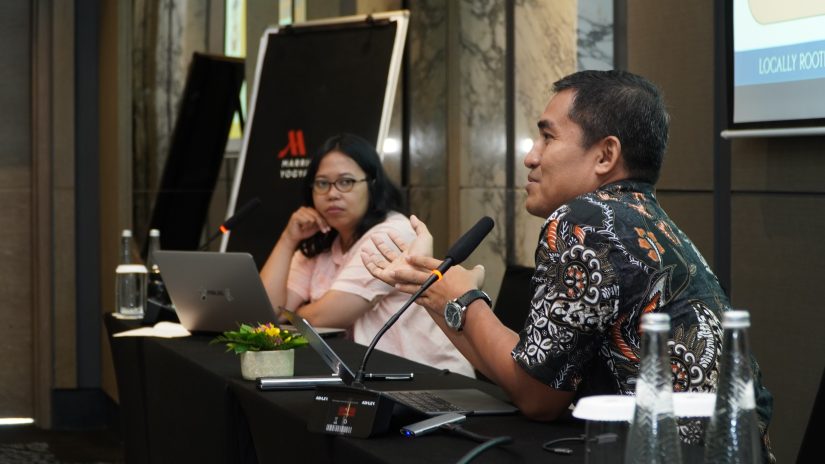
The Faculty of Philosophy at Universitas Gadjah Mada (UGM) continued its Workshop on Organizational Structure and Governance (SOTK) and Curriculum with a dedicated session on curriculum development held on Thursday (Jan. 22) at the Marriott Hotel Yogyakarta. The session focused on outlining the direction and policy framework of the UGM 2026 Curriculum as a reference for curriculum development at the faculty and study program levels.
The session featured the Secretary of UGM’s Directorate of Education and Teaching, Dr. Sigit Priyanta, S.Si., M.Kom., as the keynote speaker. In his presentation, he explained that the UGM 2026 Curriculum Structure introduces several significant changes, particularly at the undergraduate (S1) level, along with adjustments at the master’s (S2) level concerning credit requirements and duration of study.
Sigit emphasized that UGM’s curriculum development is grounded in an Outcome-Based Education (OBE) approach, centered on Graduate Learning Outcomes (Capaian Pembelajaran Lulusan/CPL). The framework places emphasis not only on the learning process but also on measurable learning outcomes. The curriculum orientation seeks to align OBE with Course Learning Outcomes (CPMK), while continuing to refer to the National Standards for Higher Education (SN-DIKTI) and the Indonesian National Qualifications Framework (KKNI).
“One of the normative values emphasized in the UGM Curriculum is transdisciplinary education. This approach is designed to accommodate the development of both major and additional fields of study, including second major and minor schemes, as a distinctive feature of education at UGM,” he said.
In addition to curriculum structure, Sigit underscored the importance of maintaining the quality of both offline and online learning, in accordance with established quality assurance guidelines. Lecturers are expected to optimally implement Outcome-Based Assessment (OBA), including through adaptive assignments and evaluation methods such as oral examinations, project-based learning, and critical analysis of the use of artificial intelligence.
On the second day of the workshop, Friday (Jan. 23), a follow-up session was held focusing specifically on the development of the undergraduate (S1) curriculum for the Faculty of Philosophy and the allocation of teaching responsibilities among lecturers. During this session, participants engaged in technical discussions and curriculum alignment to ensure consistency with the UGM 2026 Curriculum policy and the faculty’s needs.
The discussions resulted in several strategic agreements, including the classification and designation of compulsory courses, intensification courses, and elective courses. In addition, provisions were formulated regarding enrollment in courses outside the study program, including cross-program schemes, as well as the distribution of courses across odd and even semesters to maintain a balanced student workload.