
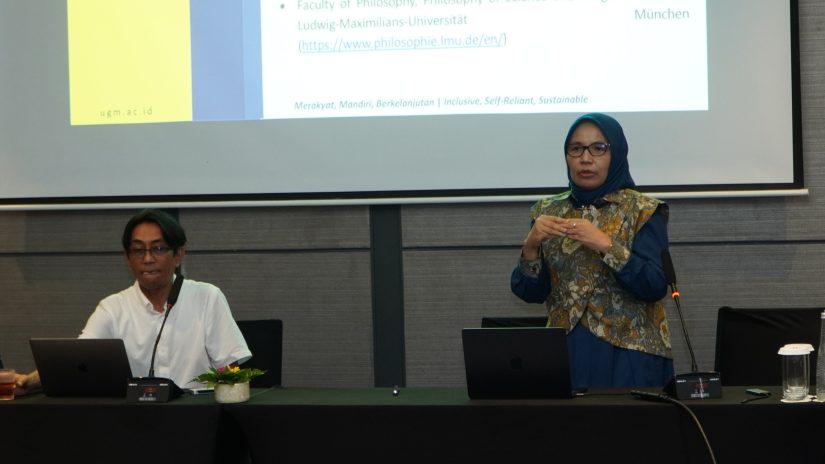
The Faculty of Philosophy at Universitas Gadjah Mada (UGM) held a workshop on Organizational Structure and Governance (SOTK) and Curriculum on January 22–23, 2026, at the Marriott Hotel Yogyakarta. The event formed part of the faculty’s ongoing efforts to evaluate and strengthen organizational governance and academic systems in line with evolving policy frameworks and institutional needs.
The first day of the workshop, Thursday (Jan. 22), focused on SOTK and Lecturer Performance Incentives (IKD). The session featured UGM’s Director of Human Resources, Prof. Suadi, S.Pi., M.Agr.Sc., Ph.D., as the keynote speaker, with the Vice Dean for Finance, Assets, and Human Resources of the Faculty of Philosophy, Dr. Hastanti Widy Nugroho, S.S., M.Hum., serving as moderator.
In his presentation, Prof. Suadi noted that academic career advancement for lecturers remains heavily influenced by scientific publication output. “To attain the highest functional academic rank, lecturers are required to prepare two internationally reputable scientific publications. This indicates that scholarly publication continues to be the primary component in evaluating lecturer performance,” he said.
He further explained that universities are still awaiting the issuance of operational guidelines for a Ministry of Administrative and Bureaucratic Reform regulation specific to lecturers, which will govern performance-based achievements. Referring to Ministerial Regulation of Higher Education, Science, and Technology No. 52, Prof. Suadi added that the policy reopens opportunities for accelerated promotion—such as from Associate Professor (Lektor) directly to Full Professor (Guru Besar)—although technical regulations on academic career management are still being formulated.
“This regulation is expected to serve as the foundation for future academic career management, with stricter requirements and a renewed reference to the 2019 credit point guidelines (PO/PAK), under which at least 45 percent of the assessment for Full Professor must derive from research,” he explained.
Prof. Suadi also outlined Lecturer Performance Targets as the minimum standard required to secure baseline income, which includes fulfilling a workload equivalent to 16 credit units (SKS). These achievements can be monitored through the Simaster system under the Human Resources menu, which displays lecturers’ eligibility status. He also reminded participants that Medical Check-Ups (MCU) are mandatory for lecturers over the age of 35.
The discussion on SOTK continued on Friday (Jan. 23), focusing on updating the Faculty of Philosophy’s organizational structure, last formulated in 2015. Dean of the Faculty of Philosophy, Prof. Rr. Siti Murtiningsih, emphasized that the restructuring effort is driven by a commitment to organizational efficiency.
“We aim to design a structure that is lean yet agile, supported by systems that can readily adapt to change,” she said.
During the session, the Faculty of Philosophy drafted a revised SOTK document, which will be submitted for consideration to UGM’s Legal and Organizational Affairs Office and further deliberated in a Faculty Senate meeting. Through this workshop, the Faculty of Philosophy reaffirmed its commitment to continuously improving governance and strengthening its academic system in a sustainable manner.